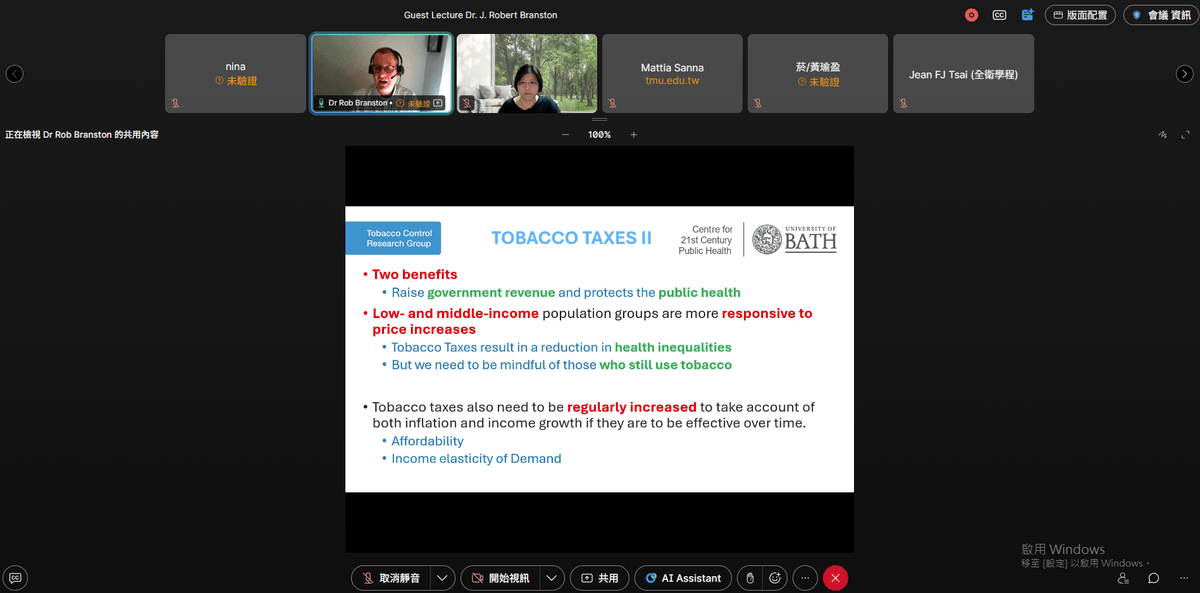
We were recently delighted to host Dr. Rob Branston from the University of Bath School of Management and the Tobacco Control Research Group (TCRG) for an eye-opening online lecture. Widely regarded as the single most effective tool to curb smoking and reduce health inequalities, tobacco taxation is designed to increase industry costs so that retail prices rise, ultimately discouraging consumption. However, while the UK stands as a leading global performer in tax policy, millions continue to use tobacco products at a staggering human and economic cost. Dr. Branston’s presentation illuminated the complex commercial tactics that big tobacco companies deploy to deliberately undermine these public health policies.
The core of the lecture exposed the six distinct pricing strategies the tobaccoindustry uses to keep their products affordable for price-sensitive consumers and prevent them from quitting. Instead of passing tax hikes on uniformly, companies cross-subsidize their products by heavily raising prices on premium brands to absorb the tax hit on ultra-cheap variants. They also introduce cheaper "downtrade pathways" like Roll-Your-Own (RYO) tobacco, execute "price smoothing" through frequent but microscopic price adjustments to avoid sudden jumps , and mask costs via "shrinkflation" by reducing pack sizes. Furthermore, companies exploit weak regulatory definitions by subtly tweaking product attributes – such as reclassifying cigarette-like cigarillos as cigars to benefit from lower tax rates.
This tax-induced product substitution poses a massive challenge for global health governance. When tax structures are inconsistent across product lines, consumers simply switch to cheaper options like RYO tobacco rather than quitting entirely. Dr. Branston noted that this dynamic preserves the exact same public health burdens while actively draining government revenue. Despite these heavy social costs, manufacturing tobacco remains phenomenally lucrative; in 2018, the world’s six largest manufacturers generated over US$55 billion in profit – out-earning food and beverage giants like Coca-Cola, PepsiCo, Nestlé, and Mondelēz combined. Adding to this distortion, these companies frequently use aggressive corporate tax avoidance strategies to shift their massive profits into low-tax jurisdictions instead of contributing back to host nations.
To counter these tactics, Dr. Branston emphasized that governments must think beyond standard, predictable tax escalators. Effective policy requires implemented tax changes to be large and entirely unexpected, minimizing the industry's ability to plan ahead and smoothly absorb the costs. Crucially, fiscal policies must fully equivalize taxes on tobacco and nicotine alternatives based on how they are actually used and sold to eliminate cheap downtrading options completely. By limiting the number of annual price adjustments, restricting brand variants, and even considering direct retail price regulations, governments can successfully take away the industry's primary weapon of strategic pricing and better protect public health.